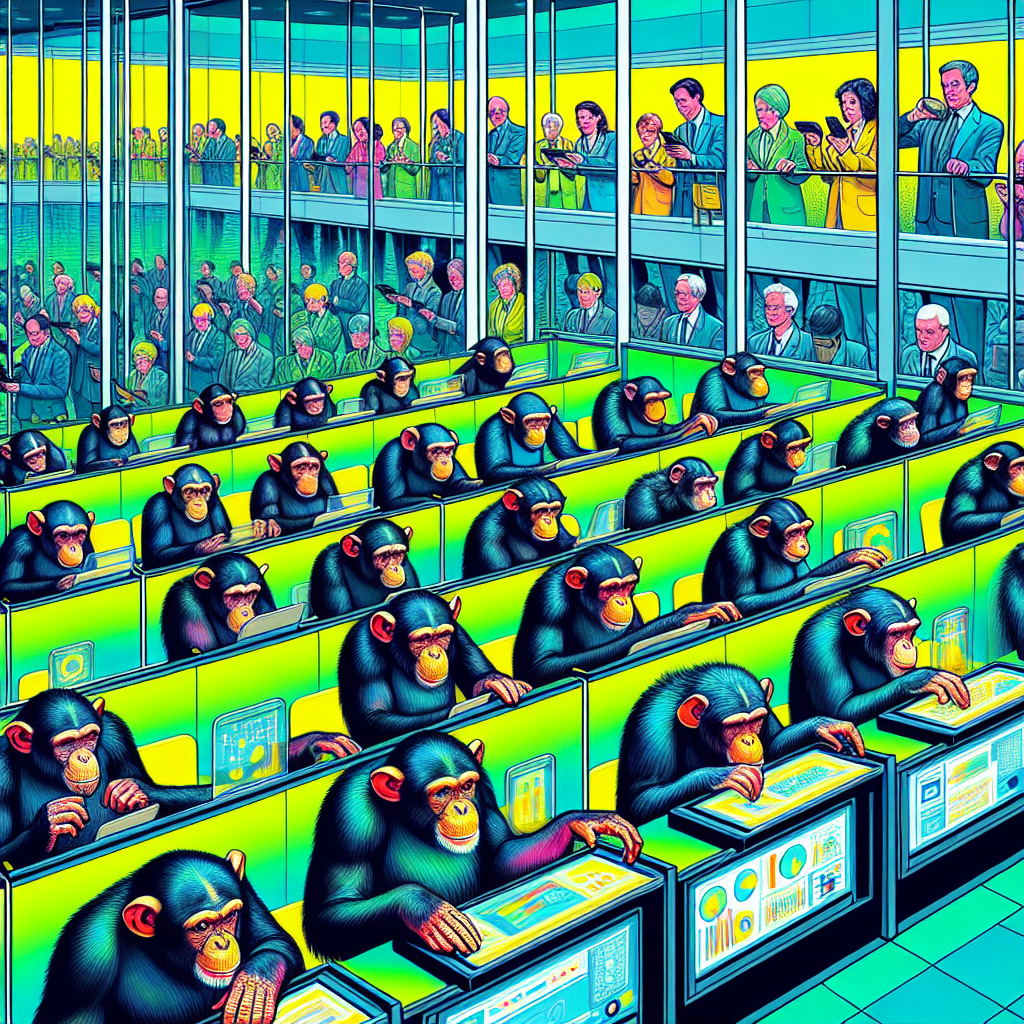
Chimpanzees and the Surprising Influence of Human Audiences
In a fascinating study published in Cell Press's iScience, researchers explored how an audience influences chimpanzees during computerized tasks, **revealing insights into the roots of a behavior common in humans.** This phenomenon, known as the 'audience effect', was thought to be primarily linked to human reputation management, but the study by Kyoto University's Christen Lin, Shinya Yamamoto, and Akiho Muramatsu suggests otherwise. Surprisingly, the study found that chimpanzees, too, are affected by the number of people observing them. Over a span of six years, the researchers analyzed thousands of sessions where chimpanzees performed touch screen tasks in a unique environment where these primates frequently interact with humans. The results demonstrated that the chimpanzees performed better on challenging tasks as the number of human observers increased, while their performance on easier tasks declined with more onlookers. Such findings underline the complexity of the relationship between the primates and humans and suggest that audience effects may not just be specific to humans. This **raises intriguing questions** about how these effects might predate the emergence of reputation-based societies in humans and could be a trait that has existed in the great ape lineage. However, the exact mechanisms behind these audience-related effects remain unclear, both in humans and chimpanzees, prompting researchers to call for further studies on non-human apes to understand how these traits evolved and why they developed in the first place.