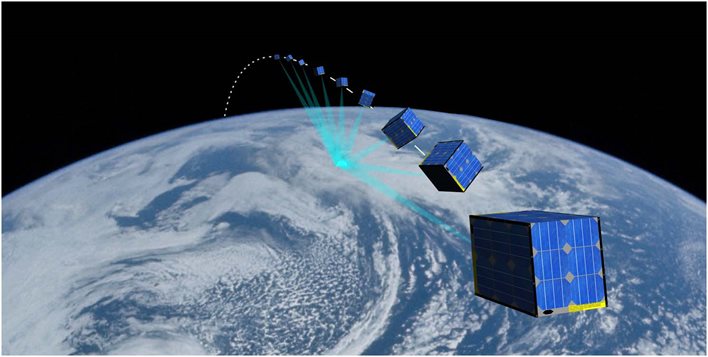
David Stanley's Innovative Approach to Cloud Tomography
**David Stanley** has designed a groundbreaking program aimed at revolutionizing the way scientists study cloud interiors and, by extension, climate change. This program utilizes **simulated satellites** to capture images of clouds from as many angles as possible, a method coined as `computed cloud tomography`. This technique, akin to a CT scan but with satellites instead of X-rays, could provide deeper insights into cloud dynamics and the convective processes that influence cloud growth and potentially amplify the greenhouse effect. Following his Master's at the University of Illinois Urbana-Champaign, Stanley pursued a Ph.D. involving exciting collaborations with NASA's Jet Propulsion Laboratory (JPL). His work, under the mentorship of **Robyn Woollands** and with input from **Federico Rossi** and **Amir Rahmani**, emphasizes the importance of understanding climate change through engineering and space exploration lenses. A key innovation in Stanley's work is the use of a **mixed integer linear program solver**, which optimizes satellite formations to maximize cloud imaging opportunities. By refining how targets are chosen for satellite imaging, Stanley's method significantly reduces computational requirements, streamlining the data collection process and enhancing efficiency. His study, published in the Journal of Spacecraft and Rockets, was supported by JPL's Spontaneous Research and Technology Development Program. While based on simulated data, this method provides a promising framework for future research using real-world cloud data, potentially transforming our understanding of cloud dynamics and contributing to more accurate climate models.