Exploring Galactic Growth Inside-Out: New Insights from Webb Telescope
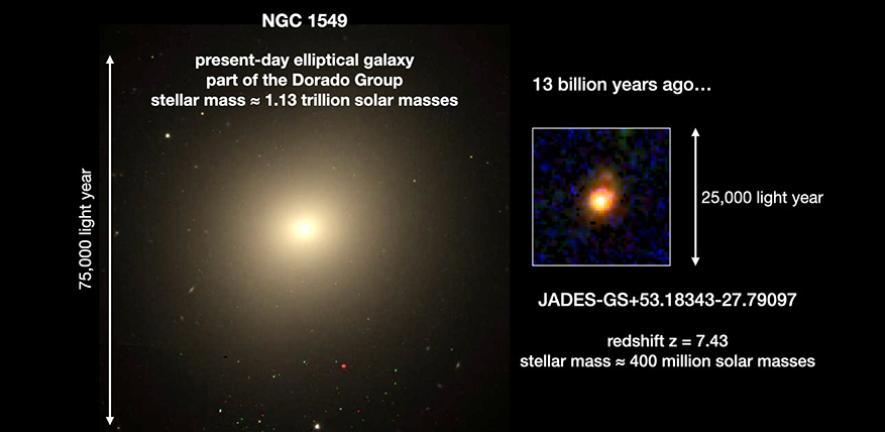
Astronomers have observed the earliest recorded instance of 'inside-out' galaxy growth, thanks to the NASA/ESA James Webb Space Telescope (JWST). This observation was made on a galaxy that existed only 700 million years after the Big Bang, described as being one hundred times smaller than the Milky Way but surprisingly mature. **Key findings include a dense core of stars within the galaxy, with accelerated star formation occurring in its suburbs, similar to a sprawling city.** Such a clear picture of galactic evolution was previously unattainable until the advent of the Webb telescope. **Dr. Sandro Tacchella, from Cambridge’s Cavendish Laboratory**, explained that Webb's ability to view galaxies billions of years back in time opens manifold possibilities for understanding cosmic history. The galaxy's development could shed light on the mechanisms driving galaxy growth in the early universe, whether through accreting gas or merging smaller galaxies. The observed galaxy is part of the JADES collaboration and features a dense core with new star formations extending outward, a growth pattern once only theorized but now observable through Webb. The study utilized stellar population modelling, estimating the number of young versus old stars to gauge the stellar mass and star formation rate. **Remarkably, the galaxy's outskirts double their stellar mass every 10 million years—a stark contrast to the Milky Way's much slower rate.** This rapid growth, alongside the high density of the core, signifies rich gas availability for new star formation in the young universe. The research indicates a need to compare this galaxy with others from the same era to establish whether this is a universal growth pattern. **Researchers aim to reconstruct the growth cycle of galaxies, possibly answering longstanding questions about their evolution to present-day structures.**