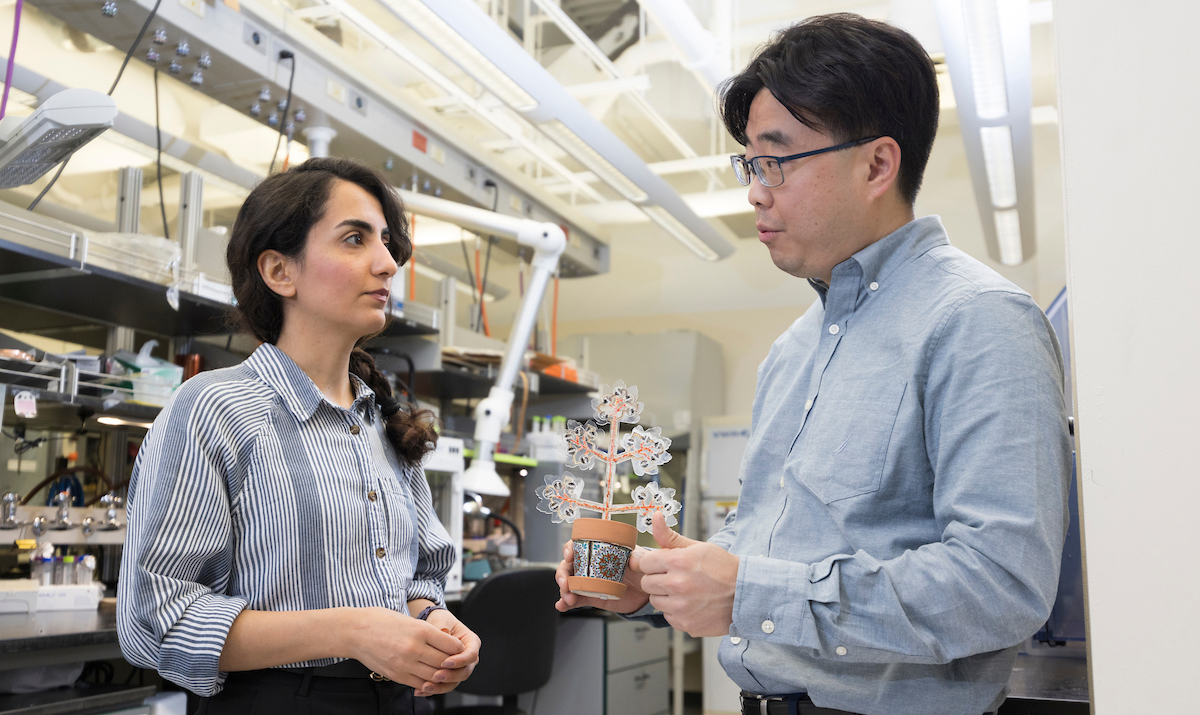
Harnessing the Power of Artificial Plants for Cleaner Air and Energy
**Binghamton University researchers**, led by Professor Seokheun “Sean” Choi and PhD student Maryam Rezaie, are transforming their work on **bacteria-powered biobatteries** into a novel solution for indoor air purification through **artificial plants**. Americans spend the majority of their time indoors, where air quality directly affects health. Most existing air purifiers are costly and require extensive maintenance, pushing these researchers to explore more efficient alternatives. Their artificial plants, capable of photosynthesis using indoor light, achieve a remarkable **90% reduction in carbon dioxide levels**, surpassing the mere **10% reduction** achieved by natural plants. This work, supported partially by the Office of Naval Research and published in *Advanced Sustainable Systems*, comes after a heightened awareness of the importance of indoor air quality post-COVID-19. Various indoor air pollutants, including carbon dioxide emissions from human activity, cooking, and external infiltration, underline the need for innovative purification systems. The concept of a bacteria-powered artificial leaf initially began as a playful experiment but quickly showed potential for broader applications. The constructed plant, comprising five leaves, was tested for its CO2 absorption and O2 production capabilities, also generating a modest power output around **140 microwatts**. Choi aims to enhance this technology to achieve a power output surpassing **1 milliwatt**, potentially enabling practical applications such as charging cell phones. Future developments may involve multi-bacteria species for prolonged efficiency and integrated systems for reduced maintenance. With further improvements, Choi envisions these artificial plants becoming commonplace in households, simplifying air purification and even offering energy benefits.