James Webb Space Telescope Unveils Carbon Dioxide and Hydrogen Peroxide on Charon
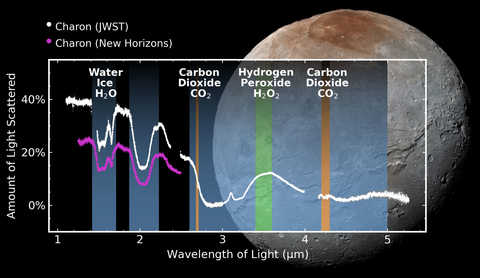
A team led by the Southwest Research Institute has made a groundbreaking discovery of **carbon dioxide and hydrogen peroxide on the surface of Charon**, Pluto's largest moon, utilizing data from the James Webb Space Telescope (JWST). This marks the first detection of these chemicals on Charon, broadening its known chemical inventory which already included water ice, ammonia-bearing species, and organic materials. **Charon is a unique midsized Kuiper Belt object**, having been geologically mapped during the 2015 New Horizons mission. This mapping, coupled with lack of obscuring volatile ices, makes Charon valuable for understanding solar exposure and cratering effects. The use of JWST's Near-Infrared Spectrograph in 2022-2023 allowed scientists to obtain comprehensive observations of Charon's northern hemisphere from various perspectives, revealing the extended wavelength signatures of carbon dioxide. It was found primarily as a veneer over a water ice-rich subsurface, likely brought to the surface by cratering events. **Hydrogen peroxide's presence suggests solar and cosmic irradiation are causing transformations on Charon's water ice surface.** These detections were supported by laboratory experiments at SwRI's CLASSE facility, which demonstrated how hydrogen peroxide forms under conditions analogous to Charon's environment. The findings underscore JWST's ability to illuminate complex surface compositions shaped by cosmic processes, with implications for understanding similar mid-sized objects beyond Neptune. The research was accomplished through a combination of Webb observations, spectral modeling, and laboratory experiments. The comprehensive study can be accessed in the Nature Communications journal.