Optical Lattice Clocks: Synchronizing Quantum Mechanics and General Relativity
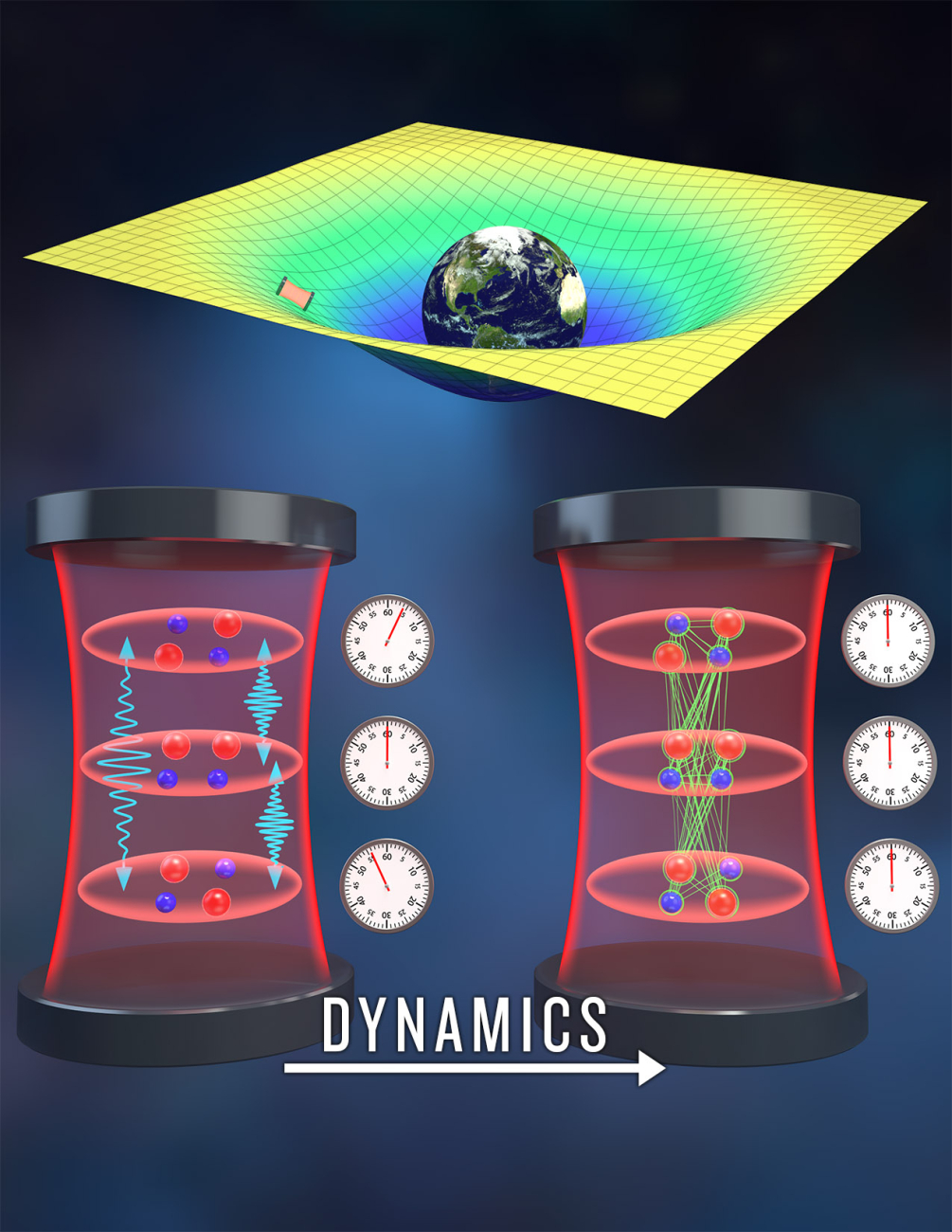
For over a century, scientists have wrestled with the challenge of reconciling the rules of **quantum mechanics** and **general relativity**. Optical lattice clocks, with their unparalleled precision, are now at the forefront in this exploration. Inside these clocks, atoms are meticulously controlled using laser beams, allowing researchers to measure **gravitational redshift**, where time is affected by gravity. JILA and NIST researchers, alongside their international partners, have developed protocols to study how these relativistic effects interact with quantum systems, particularly focusing on **quantum entanglement** and **synchronization** among particles. One innovative method employed is the **dressing protocol**, which fine-tunes gravitational effects by altering particle states with laser light—leveraging **Einstein’s mass-energy equivalence**. This precision enables researchers to distinguish genuine gravitational effects from other noise. The team found that photon-mediated interactions within an optical cavity can synchronize atomic oscillations, counteracting the desynchronization caused by gravitational pull, further leading to quantum entanglement. This discovery marks a critical step towards understanding the interplay of gravity and quantum interactions, providing new insights into the fundamental experiments of modern physics. The implications of this research go beyond theoretical interest, paving the way for advanced experimental techniques with potential applications in quantum computing and a deeper understanding of physics. Supported by notable foundations, this work represents a significant leap forward in bridging the two pillars of modern scientific inquiry.