Revolutionary Breakthrough: Nonlinear Compton Scattering Achieved with All-Optical Setup
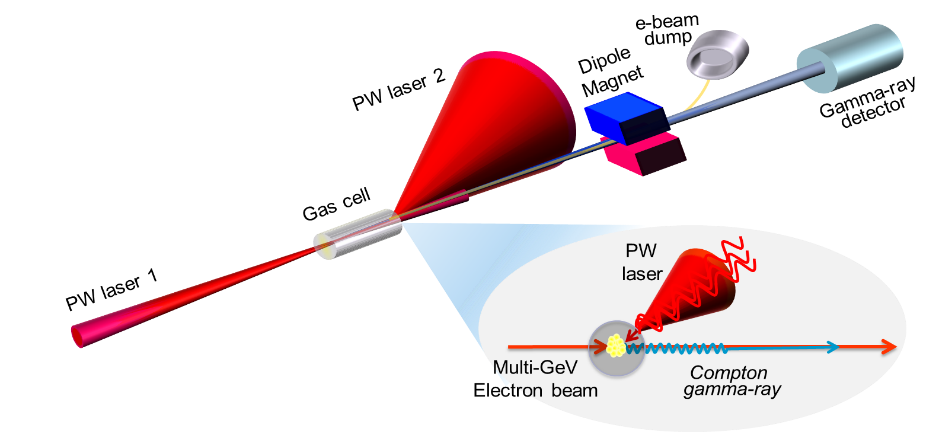
**Nonlinear Compton Scattering (NCS)** has been demonstrated in a groundbreaking experiment using the 4-Petawatt laser at the Center for Relativistic Laser Science (CoReLS), Korea. This **'all-optical' setup** marks a significant advancement in **strong field physics**, particularly in **strong field quantum electrodynamics (QED)**. The traditional need for long particle accelerators has been bypassed by using a powerful laser both for acceleration and for collision. **Key Techniques:** - **Laser Wakefield Acceleration (LWFA):** Electrons are accelerated using the laser to 'surf' plasma waves, reaching near-light speeds. - **Collided Beams:** A finely focused laser pulse collides with these ultra-fast electrons, enabling them to absorb multiple photons and emit a single high-energy gamma-ray photon. **Technical Achievements:** - Using Einstein's theory of relativity, researchers approached 50% of the **Schwinger limit** laser intensity from the electron's perspective, triggering nonlinear QED effects. - An **extremely high brightness gamma-ray beam** was produced, 1,000 times brighter than previous laboratory achievements. Through thorough analysis involving **Monte-Carlo simulations** and **particle-in-cell simulations**, experimental results were verified against theoretical models. The study showcases potential applications in understanding **nuclear processes** and **antimatter production**, with implications for astrophysical phenomena. Future experiments are planned in various global facilities to further explore these advancements.