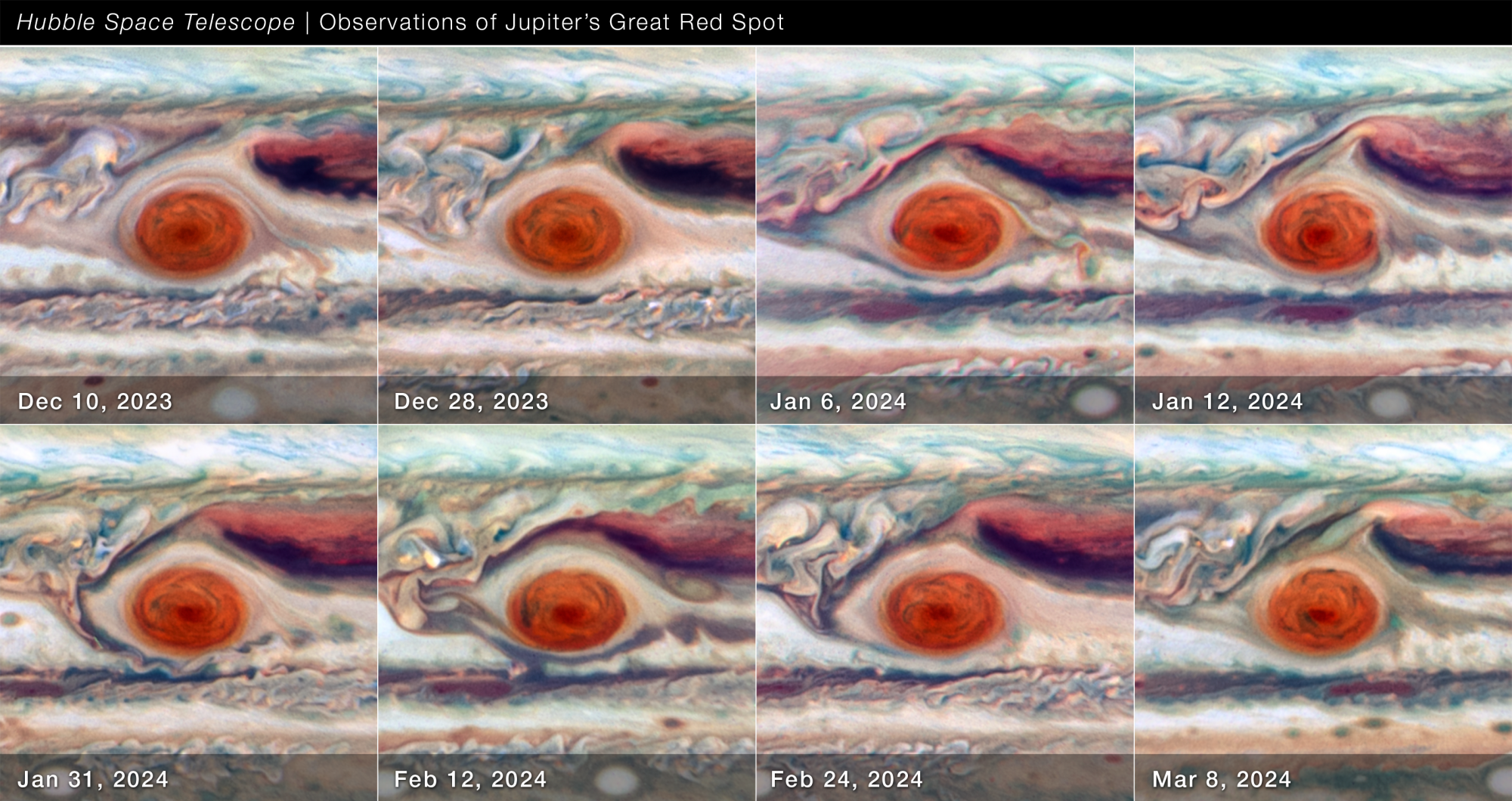
The Great Red Spot: Jupiter's Iconic Storm Reveals New Oscillations
Astronomers using NASA's Hubble Space Telescope have discovered that Jupiter's Great Red Spot (GRS), a massive storm that can fit Earth inside it, jiggles like gelatin. Observations over 90 days reveal an unexpected oscillation in the storm's size and speed, captured in a time-lapse movie. This behavior has never been identified before. **Amy Simon**, leading the study from NASA's Goddard Space Flight Center, explains that while longitude motion variations were known, the size oscillation is a new finding. The high-resolution imaging cadence allowed precise observations, showing the GRS squeezing in and out while accelerating and decelerating. Currently, there are no hydrodynamic explanations for this behavior. Hubble's observations are part of the Outer Planet Atmospheres Legacy program, which annually monitors outer solar system planets. This program helps put Earth's hurricane theories into a cosmic perspective, potentially aiding understanding of meteorology on exoplanets. The team, led by Simon, observed color changes and oscillations in ultraviolet light, noting that the storm's core gets brighter when the GRS is largest. Co-investigator Mike Wong of UC Berkeley likened the phenomenon to an overstuffed sandwich that bulges due to pressure. The GRS has been shrinking during the OPAL program's 10-year span. The researchers predict stabilization in a less-elongated shape once it fits within its latitude band, held by surrounding jet streams. This study, presented at the American Astronomical Society's Division for Planetary Sciences meeting, holds promise for future high-resolution Hubble observations to uncover the cause of GRS oscillations.