The Secret Diets of Borneo's Civets: Unraveling Tropical Coexistence
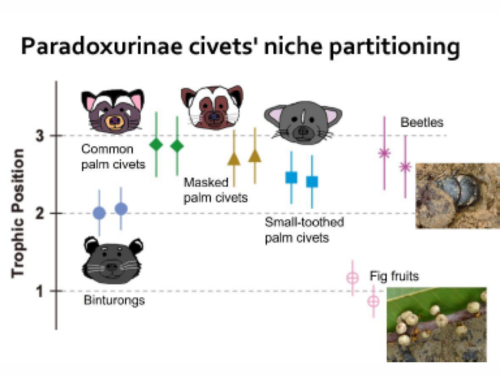
In the rainforests of Borneo, a fascinating ecological mystery unfolds: how do four closely related civet species—binturong, small-toothed palm, masked palm, and common palm civets—share the same habitat despite similar diets? Typically, such species would compete intensely for the same resources, leading to displacement or extinction of one or more. However, a **study published in Progress in Earth and Planetary Science** utilizes **compound-specific nitrogen isotope analysis** to reveal a unique solution to this conundrum. Researchers, confronted with the challenge of studying these elusive, nocturnal animals, turned to isotopic analysis, which provided insights beyond what mere observation could achieve. By examining the nitrogen isotope ratios in the civets' hair, scientists deduced their dietary patterns and trophic positions. The analysis showed that, contrary to past beliefs, faunivory plays a significant role in the diets of three of the civet species. The **binturong**, however, showed a remarkable deviation with a diet resembling that of plant-eating animals, showcasing the lowest degree of faunivory. This study demonstrates that **niche partitioning through varying degrees of faunivory** is a key mechanism for coexistence. The findings indicate that while all four species consume fruits, their reliance on animal protein varies, allowing them to minimize direct competition. As researchers continue to explore the complexities of tropical rainforests, they aim to uncover **additional mechanisms** that enable not just civets but other closely related species to coexist. This study is a stepping stone towards understanding biodiversity in one of Earth’s most species-rich environments.