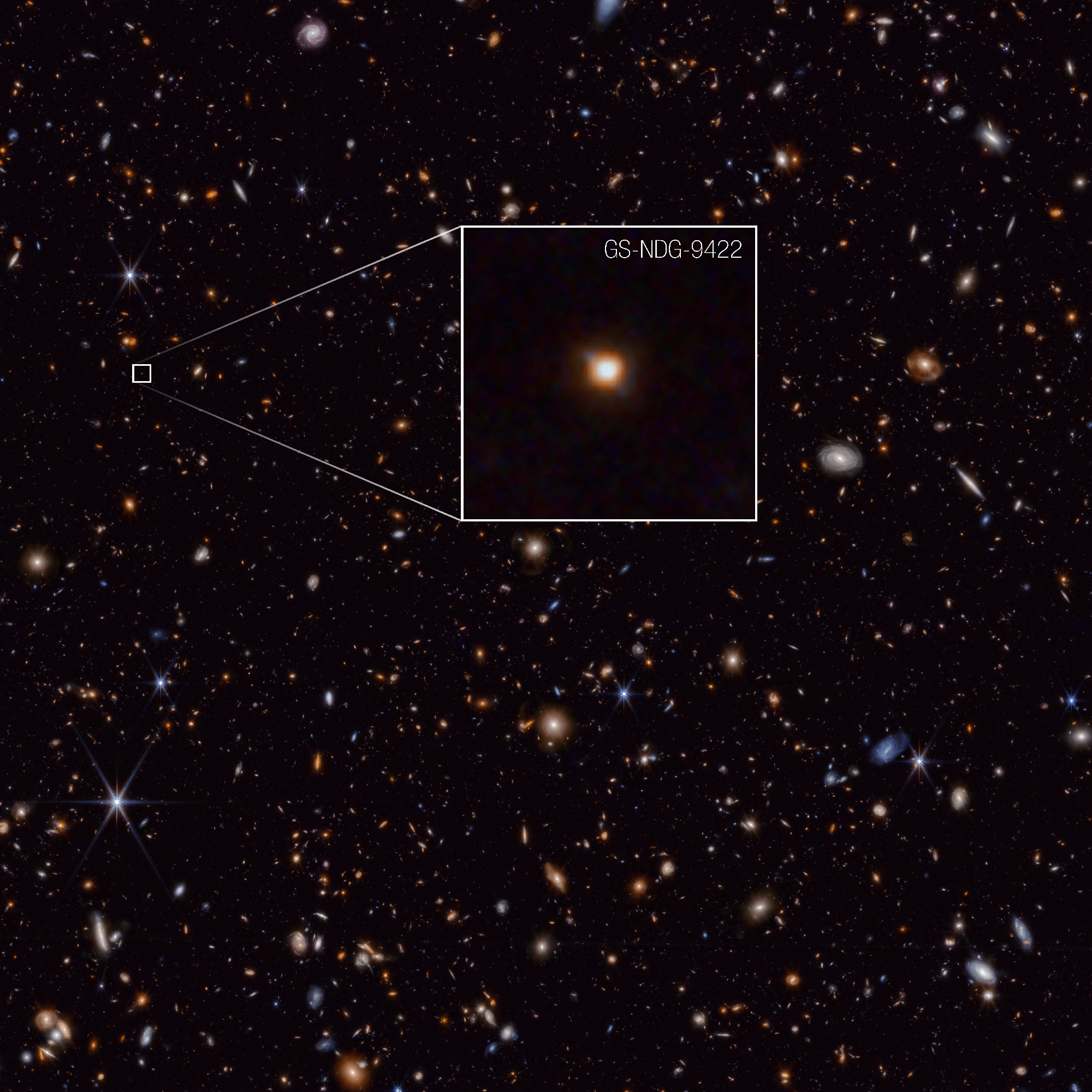
Unveiling the Secrets of Early Galaxies: NASA's Webb Telescope Discovers a Gas Outshining Stars
NASA's James Webb Space Telescope has made an unprecedented discovery in the form of **galaxy GS-NDG-9422**, which exhibits a unique light signature where its gas outshines its stars. Detected approximately one billion years after the Big Bang, this phenomenon may represent a missing link between the universe’s primordial stars and the well-established galaxies we recognize today. **Alex Cameron**, lead researcher from the University of Oxford, and colleague Harley Katz, identified that the light spectrum of the galaxy aligns closely with theoretical models of cosmic gas clouds lit by very hot, massive stars. **In the early universe**, these stars could reach temperatures exceeding **140,000 degrees Fahrenheit (80,000 degrees Celsius)**, far hotter than those observed locally. This intense star formation process in dense gas clouds could explain why the gas appears brighter than the stars themselves. Interestingly, this characteristic echoes predictions made about **Population III stars**, the universe’s first generation of stars, although 9422's stars aren't typical Population III due to their chemical complexity. The discovery raises questions about whether such conditions were common or rare during this period of galaxy development. Researchers are actively seeking more galaxies with similar traits to further explore these early cosmic scenarios. **Published in the Monthly Notices of the Royal Astronomical Society**, this research marks the beginning of new revelations regarding galaxy evolution and the early universe, as the Webb telescope continues to explore previously inaccessible cosmic timelines.